


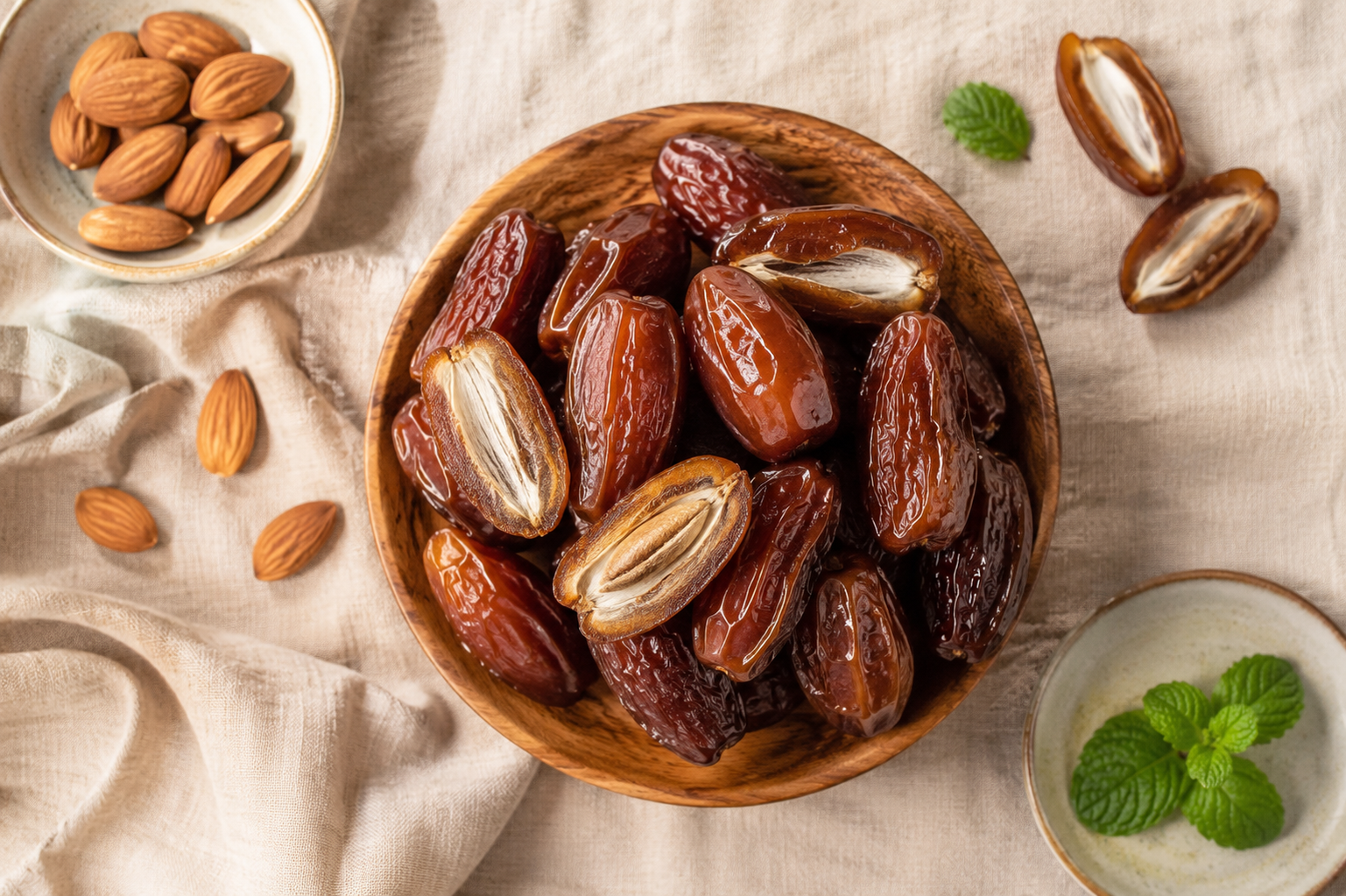
A 100g serving of dates (roughly 5-6 medium dates) has about 277 calories, 75g of carbohydrates, 6.7g of fiber, and a solid dose of potassium, magnesium and iron. That's according to USDA FoodData Central figures for dried dates, and it's the number most nutritionists point to when they call dates a "whole food sweetener" rather than just sugar.
If you've ever wondered why a handful of dates keeps you full longer than a chocolate bar with similar calories, the answer is in that fiber number. Let's break down what's actually in a date, and why the variety you pick changes the picture more than you'd expect.
100g of dried dates contains approximately 277 calories, most of it from natural sugars (glucose, fructose and sucrose) rather than added sugar. That works out to around 20 calories per date if you're eating the medium-sized variety, which is why a small handful goes further than most people assume.
Fresh dates, before they're dried, have noticeably fewer calories per 100g since they still carry more water weight. Once dried, the sugar concentration goes up simply because the water content drops. This is worth knowing if you're comparing a fresh Ajwa date against a dried one on a nutrition label and the numbers don't match what you expected.
For context: 100g of dates has roughly the same calorie count as 100g of raisins, but noticeably fewer calories than the same weight of cashews or almonds, which sit closer to 550-600 calories per 100g because of their fat content.
Dates are genuinely one of the better plant sources of potassium, with around 696mg per 100g, more than a medium banana. They also carry meaningful amounts of magnesium (54mg), copper, manganese, and vitamin B6 (0.249mg), plus smaller amounts of iron and calcium.
| Nutrient (per 100g) | Approximate Amount |
| Calories | 277 kcal |
| Carbohydrates | 75g |
| Dietary Fiber | 6.7g |
| Sugars | 63g |
| Protein | 1.8g |
| Fat | 0.2g |
| Potassium | 696mg |
| Magnesium | 54mg |
| Iron | 0.9mg |
| Vitamin B6 | 0.249mg |
Potassium and magnesium together are why dates get recommended for muscle function and blood pressure support, though the effect from food alone is modest, it's a contribution, not a substitute for a balanced diet. If you're tracking electrolytes for workouts or just trying to eat less processed sugar, dates are a reasonable swap.
At 6.7g of fiber per 100g, dates deliver close to a quarter of the recommended daily fiber intake in a single small serving, which slows down how quickly the natural sugars hit your bloodstream. This is the main reason dates don't spike blood sugar the same way a plain sugar hit does, even though they taste intensely sweet.
That fiber is mostly insoluble, which supports regular digestion, it's part of why dates have been used as a mild, food-based approach to constipation for generations, not just in South Asian households but across the Middle East too. It's not a medical treatment, but it's a reasonable, low-effort dietary habit.
For anyone managing sugar intake carefully, including people with diabetes, this doesn't mean unlimited dates are fine. Portion still matters. A doctor or dietitian is the right person to set an exact number for a specific health condition.
Dates come out ahead of both banana and raisins on potassium and fiber per 100g, though raisins edge out dates slightly on calories and iron since they're more concentrated.
| Nutrient (per 100g) | Dates | Banana | Raisins |
| Calories | 277 kcal | 89 kcal | 299 kcal |
| Carbohydrates | 75g | 23g | 79g |
| Dietary Fiber | 6.7g | 2.6g | 3.7g |
| Sugars | 63g | 12g | 59g |
| Protein | 1.8g | 1.1g | 3.1g |
| Potassium | 696mg | 358mg | 749mg |
| Iron | 0.9mg | 0.3mg | 1.9mg |
The practical takeaway: dates and raisins are both dried, calorie-dense snacks best eaten in small portions, while banana works better as a larger, lower-calorie everyday fruit. None of the three is strictly "better", they suit different situations depending on whether you want a quick energy source or a lower-calorie snack you can eat more of.
Yes, and the difference is bigger than most people expect. Medjool dates run slightly higher in calories and natural sugar per piece simply because they're larger and softer, while Ajwa dates are smaller and often described as having a firmer, less syrupy texture with a subtly different antioxidant profile tied to their darker color.
Khudri and Mabroom dates sit somewhere in between, moderately sweet, firm, and commonly used for daily eating rather than as a dessert-style date. If you're buying dates specifically as a health-focused snack rather than a treat, checking the variety on the label is worth the extra ten seconds.
You can see the full range, including Medjool dates, in our dates collection, each product page lists the pack weight so you can work out the per-100g numbers for exactly what you're buying.
Dates can fit into a weight-conscious diet, but they're calorie-dense, so portion control matters more than with lower-calorie fruits like berries or watermelon. Three to four dates a day is a commonly cited moderate serving that provides fiber and micronutrients without derailing a calorie target.
The trick is what you pair them with. Dates alongside a source of protein or fat, a few almonds, a spoon of peanut butter, slow digestion further and tend to keep hunger away longer than dates eaten alone.
Dates are calorie-dense but nutrient-rich, offering real fiber, potassium and magnesium in a small serving, which is a fair trade if you're eating them in place of refined sugar rather than on top of it. The variety you choose changes the details slightly, but the core nutrition story holds across the board: this is a whole food, not a candy.
Want to taste the difference variety makes? Browse our Ajwa dates or see the full dates range to find the one that fits your routine.
A single medium date has roughly 20-23 calories, depending on the variety. Larger Medjool dates run slightly higher, closer to 25-30 calories each.
Yes, dates are naturally high in sugar, around 63g per 100g. It's fruit sugar, not added sugar, and comes packaged with fiber that slows absorption but portion control still matters, especially for anyone monitoring blood sugar.
No single variety wins across the board. Ajwa dates are often highlighted for their antioxidant content, while Medjool dates tend to have a slightly higher mineral density simply because they're larger per piece.
Date paste or chopped dates work well as a partial sugar substitute in baking and smoothies, adding fiber and nutrients that refined sugar doesn't offer. They won't behave identically to sugar in every recipe, so some experimentation is usually needed.